



🌞What’s the Difference and Which One Should You Choose?
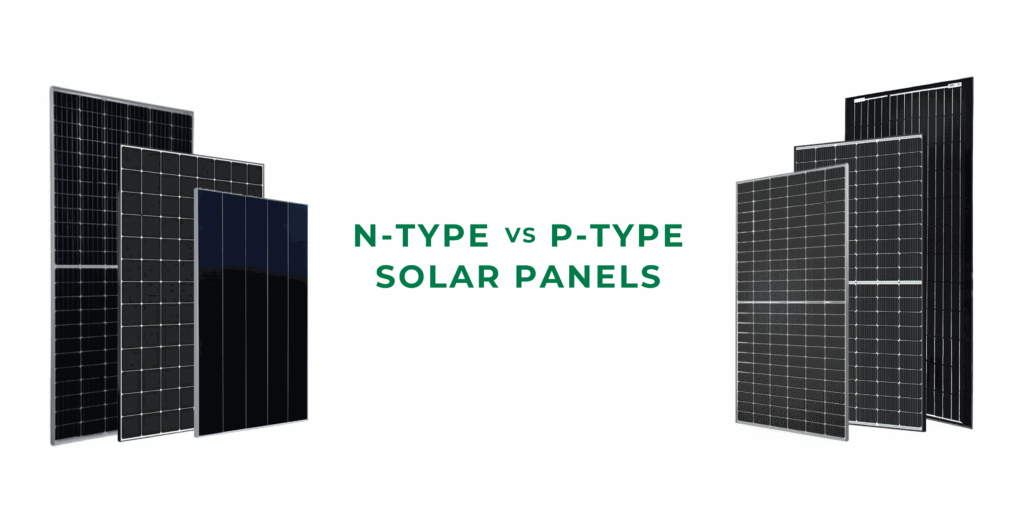
As solar technology continues to evolve, homeowners, businesses, and solar enthusiasts are increasingly faced with a choice between N-Type and P-Type solar panels. While both types harness the sun’s energy to generate electricity, they differ significantly in terms of materials, efficiency, longevity, and cost.
In this blog, we’ll break down the key differences between N-Type and P-Type solar panels to help you make an informed decision.
🔬 What Are N-Type and P-Type Solar Panels?
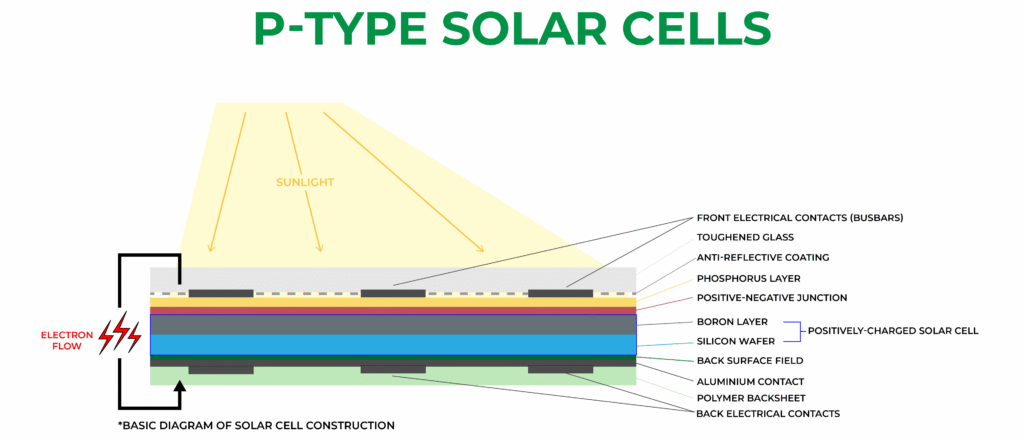
At the core of every solar panel is a semiconductor material, typically silicon, that converts sunlight into electricity. The difference between N-Type and P-Type panels lies in how this silicon is doped (i.e., infused with other elements to alter its electrical properties).
✅ P-Type Solar Panels
- Base Material: Positively doped silicon (usually boron).
- Charge Carriers: Holes (positive charge).
- Common Technology: PERC (Passivated Emitter and Rear Cell).
- Market Share: Historically dominant due to lower production costs.
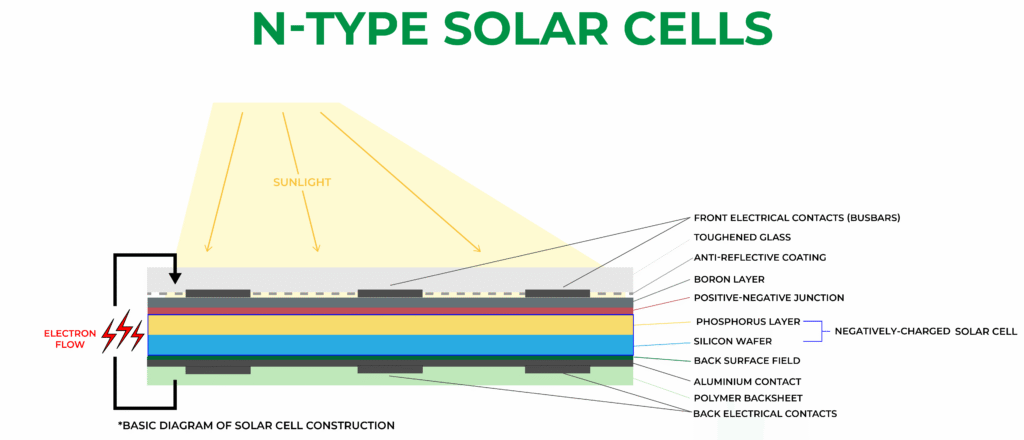
✅ N-Type Solar Panels
- Base Material: Negatively doped silicon (usually phosphorus).
- Charge Carriers: Electrons (negative charge).
- Common Technology: TOPCon (Tunnel Oxide Passivated Contact), HJT (Heterojunction Technology).
- Market Trend: Rapidly growing due to superior performance.
⚖️ Key Differences Between N-Type and P-Type Panels
| Feature | P-Type Panels | N-Type Panels |
|---|---|---|
| Efficiency | 18–21% | 20–23% |
| Degradation Rate | Higher (LID and PID) | Lower (resistant to LID) |
| Temperature Coefficient | Slightly worse | Better performance in heat |
| Cost | Lower upfront cost | Higher upfront cost |
| Lifespan | 25–30 years | 30+ years |
| Light-Induced Degradation (LID) | Affected | Not affected |
| Power Output Over Time | Declines faster | More stable |
| Manufacturing Complexity | Simpler | More complex |
🔍 In-Depth Comparison
1. Efficiency
N-Type panels generally offer higher efficiency due to better electron mobility and reduced recombination losses. This makes them ideal for limited roof space or high-performance applications.
2. Degradation and Longevity
P-Type panels suffer from Light-Induced Degradation (LID) and Potential-Induced Degradation (PID), which reduce their performance over time. N-Type panels are more stable and degrade more slowly, often retaining over 90% of their original output after 25 years.
3. Temperature Performance
N-Type panels typically have a better temperature coefficient, meaning they lose less efficiency as temperatures rise—an important factor in hot climates.
4. Cost Considerations
While N-Type panels are more expensive to produce, their longer lifespan and higher efficiency can lead to better long-term value and lower levelized cost of electricity (LCOE).
🏠 Which One Should You Choose?
Choose P-Type if:
- You’re on a tighter budget.
- You have ample roof space.
- You’re installing in a moderate climate.
Choose N-Type if:
- You want the highest efficiency and performance.
- You’re in a hot or humid environment.
- You’re planning a long-term investment or commercial project.
🔮 The Future of Solar: N-Type on the Rise
With advancements in TOPCon and HJT technologies, N-Type panels are becoming more affordable and are expected to dominate the market in the coming years. Major manufacturers are already shifting production toward N-Type cells due to their superior performance and durability.
🌟 Final Thoughts
Both N-Type and P-Type solar panels have their place in the solar ecosystem. The right choice depends on your specific needs, budget, and long-term goals. As technology advances, N-Type panels are poised to become the new standard—but P-Type panels still offer excellent value for many users.
Leave a Reply